
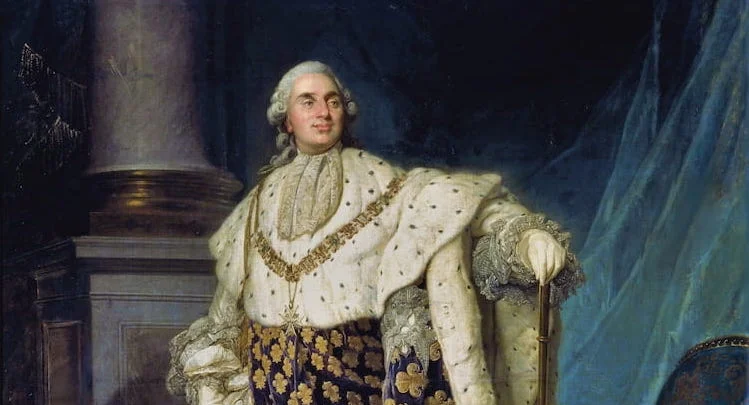
Louis XVI in Coronation Robes (Louis XVI 1754-93) painted by Joseph Siffred Duplessis
"Oh its good to be the King"
An amusing line from a 1981 Mel Brooks movie 'History of the World Part I' which paints a funny but stout mono picture of the French Revolution and Louis XVI. And with ‘Bad’, often being a better topic than ‘Good’, we delve into some of the wider annals of Monarch history.
The worst perception of King Louis XVI that directly fuelled the French Revolution was that of a weak, indecisive, and ineffectual leader who was indifferent to the suffering of his people. While some historians consider Louis was personally well-intentioned and not a tyrant by nature, this perception of him as a timid and apprehensive ruler created a vacuum of authority that, when combined with a severe economic crisis, made him the focus of intense public rage.
As an absolute monarch, Louis was held personally responsible for the financial ruin of France, including the high cost of bread, often costing more than three quarters of a common worker's wages.
Though it was often unfair, the public perceived him as being under the thumb of his unpopular, foreign (Austrian) wife, Marie Antoinette but his preference for personal hobbies, such as hunting and locksmithing, over the business of state fostered an image of a king who was self indulgent and detached from the daily struggles of his subjects and his country.
While the French Revolution would show the end results of that trait of gluttony, many kings, and queens have somewhat overstepped the boundaries of self absorbed enjoyment, and then again there are some who haven't.
BMK Workshop’s Medieval card games are representative versions of this and other Medieval monarchy’s of the time - and it is hopefully an enjoyable way for children, adults or gamers to learn about and see processes of those periods so much different from our own today, as well as having some fun playing an easy to grasp card game that demonstrates the widening gap and sentiments between the rich and poor, and the rule of a monarchy against the desire for a democracy.
Other bad kings or rulers include King Leopold II of Belgium, Ivan IV of Russia, Queen Ranavalona I of Madagascar, and of course the Roman Emperor Caligula (Hmm, a king? Well he certainly thought he was).
Historical records of "bad" rulers are sometimes exaggerated by later, competing political regimes, such as the Tudors on Richard III or the monks on King John, but many monarchs are consistently cited in historical studies as having had negative impacts on their kingdoms.
There are also those who are historically thought of as good kings like Cyrus the Great of Persia, Ashoka the Great of India, Augustus of Rome, Alfred the Great of Wessex, and Charlemagne of the Franks.
The definition of a "good" ruler can vary based on the period, with early monarchs valued for strength and defence, and later ones for economic and social development.
While not all these 'Rulers' were operating within the Medieval Era, if this has peaked your interest, then Order the Medieval KINGDOM card pack, or if you already have, put down the phone now, or turn off the computer, grab the cards off the shelf and get your siblings away from the television, or your friends over, or you parents for a half hour, detach yourselves for a while, and see if you can build your Medieval KINGDOM before they do. Its a great game if your also interested in a different version of Poker or Canasta type card games.
What was the worst perception of King Louis of France which lead to the French Revolution?
The worst perception of King Louis XVI that directly fuelled the French Revolution was that of a weak, indecisive, and ineffectual leader who was indifferent to the suffering of his people. While Louis was personally well-intentioned and not a tyrant by nature, this perception of him as a "timid" and "unimaginative" ruler created a vacuum of authority that, when combined with a severe economic crisis, made him the focus of intense public rage.
Key facets of this damaging perception included:
Indecisiveness and Weakness: Louis was viewed as completely unsuited to handling the political turmoil of his time. His tendency to vacillate between reform and resisting popular demands allowed the crisis to deepen and encouraged the belief that he was incapable of governing.
"The Last" and Traitor: Following his failed attempt to flee the country in 1791 (the Flight to Varennes), the perception shifted from merely incompetent to actively treasonous. He was seen as a traitor to the revolution, conspiring with foreign powers to restore his absolute rule, which earned him the nickname "Louis the Last" and directly led to his execution.
Responsibility for Economic Misery: As an absolute monarch, Louis was held personally responsible for the financial ruin of France, including the high cost of bread (often costing 90% of a worker's wages).
Isolation and "Locksmith" King: His preference for personal hobbies, such as hunting and locksmithing, over the business of state fostered an image of a king who was "detached" from the daily struggles of his subjects.
Association with Foreign Influence: Although it was often unfair, the public perceived him as being under the thumb of his unpopular, foreign (Austrian) wife, Marie Antoinette, which weakened his legitimacy.
In essence, the worst perception was that Louis was a "walking Hanlon’s Razor"—not maliciously evil, but so incompetent and inflexible that he might as well have been.
What other kings or queens have been recorded as bad for their kingdom?
Throughout history, numerous kings and queens have been recorded as detrimental to their kingdoms, often due to tyranny, incompetence, mental instability, or excessive greed. Notable examples range from absolute rulers who caused mass suffering to weak leaders who allowed their nations to crumble, including Ivan the Terrible, King Leopold II, and "Bloody Mary."
Here are several more kings and queens recorded as bad for their kingdoms:
Absolute Tyrants and Cruel Rulers
King Leopold II of Belgium (1865–1909): Widely considered one of the worst monarchs in history, he established the Congo Free State as a private colony, causing the deaths of an estimated 3 to 15 million people through a brutal forced-labour system that extracted rubber and ivory.
Ivan the Terrible (Ivan IV of Russia, 1533–1584): While he expanded Russian influence, his later reign was defined by extreme paranoia, torture, and sadistic executions. He created the oprichnina (a secret police) that terrorized the nobility, sacked Novgorod, and famously killed his own son in a fit of rage.
Ranavalona I of Madagascar (1828–1861): Known as the "Mad Queen of Madagascar," she enforced extreme isolationism and used forced labour (fanompoana) as tax payment, which led to significant population decline and economic ruin.
While not medieval, and technically not classified as a king, this one is worth mentioning. Caligula (Roman Emperor, 37–41 CE): Infamous for his cruelty and decadence, he was rumoured to have planned to appoint his horse as a consul, engaged in political purges to seize wealth, and indulged in public torture.
Vlad III (Vlad the Impaler of Wallachia): Famous for his brutal, excessive impaling of thousands of people, including his own subjects and enemies.
Incompetent and Weak Leaders
King John of England (1199–1216): Often regarded as England's worst monarch, "Bad King John" lost almost all English holdings in France, was excommunicated by the Pope, and was so tyrannical that his barons forced him to sign the Magna Carta in 1215.
Henry VI of England (1421–1471): A weak, pious, and mentally ill ruler whose inability to govern led to the collapse of English power in France and helped trigger the Wars of the Roses, a brutal civil war.
Edward II of England (1307–1327): Infamous for his military incompetence and blatant favouritism, his poor leadership led to massive political chaos and his eventually forced abdication.
Louis XVI of France (1774–1792): Not known for cruelty, but for indecisiveness and failure to manage a severe financial crisis, which directly contributed to the French Revolution.
Emperor Wu Zetian (China): While a trailblazer, she is often recorded for using a secret police to purge opponents and maintaining a ruthless edge to hold power.
Destructive Religious or Social Policies
Mary I of England (1553–1558): Known as "Bloody Mary," she persecuted, tortured, and executed hundreds of Protestants, attempting to reverse the English Reformation, which caused chaos and crisis.
Aurangzeb (Mughal Emperor, 1658–1707): A religious fanatic whose policies of bigotry and persecution caused the destruction of thousands of temples and resulted in the bloodiest chapter of Indian history.
Queen Elizabeth I of England: Despite her popularity, some accounts describe her as a tyrant who executed thousands of Catholics, crushed the religious rights of her subjects, and left the country in debt.
"Mad" or Eccentric Monarchs
Charles VI of France (1380–1422): Known as "Charles the Mad," his profound mental illness plunged France into chaos, allowing rival factions to rip the kingdom apart.
George III of England (1760–1820): While complex, his bouts of severe mental illness, which caused paranoia and incapacity, left him despised and "mad" in the eyes of many during the American and French Revolutions.
Note: Historical records of "bad" rulers are sometimes exaggerated by later, competing political regimes (such as the Tudors on Richard III or the monks on King John), but the monarchs listed above are consistently cited in historical studies as having had negative impacts on their kingdoms. So how will some of the Monarchs of our contemporary era fare in future historical annals? This will be the purview of our grandchildren and great children.