
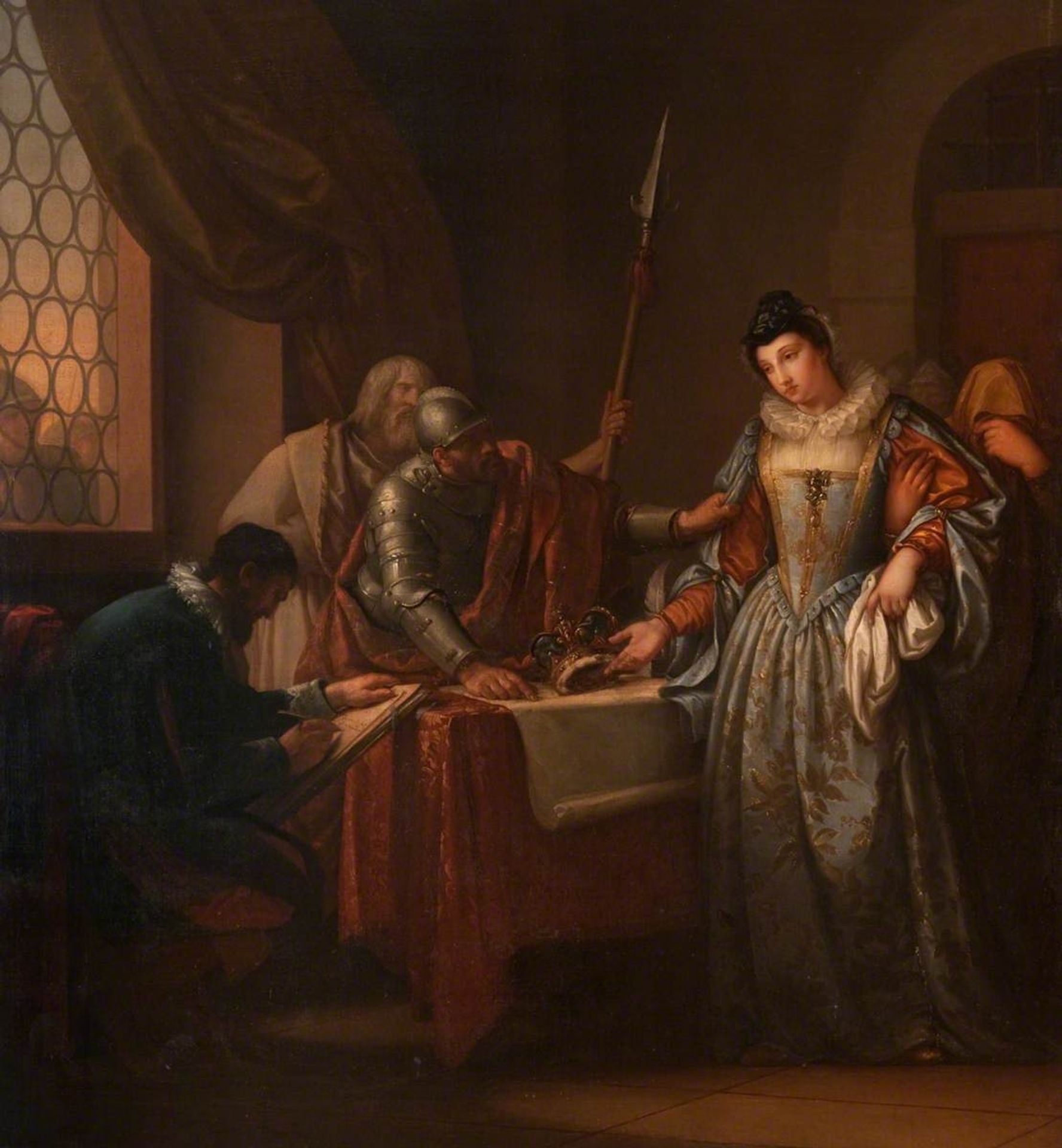
The Abdication of Mary Queen of Scots in 1568 by Gavin Hamilton (1723-1798).
Amidst the cards of the KINGDOM card game (an original card game designed by BMK Workshop in 2022), the first of the Medieval set of three card games which can be played individually or all together, the Queen is at the top of the Fuedal or Monarchal system needed to try and win the game.
queens were predomintely thought of as ... mother & propagator in a time where men were the apex of society and governance ...
In the medieval period, queens were viewed through a complex, dualistic lens: they were officially seen as necessary dynastic agents and partners in rule, while also being suspected of acting as "alien" outsiders or dangerous, meddling influences. While their primary, essential role was to secure the royal line by producing heirs, they were also expected to act as pious, merciful intercessors between the king and his subjects, managing the royal household, and, at times, acting as powerful regents or diplomats.
Perceived to their kingdoms as The Dynastic Progenitor and "Mother of the Nation"
The foremost, and often only, expectation of a queen was to ensure the continuation of the dynasty was a 'brood mare' and mother to the male progeny for the king.
Many medieval queens were not native to the territory they ruled, leading to a complex, sometimes suspicious, public perception.
While many queens were respected, those who exercised too much power or stepped outside traditional gender roles were often viewed with suspicion and fear, sometimes depicted as usurping power or unnatural and dangerous by chroniclers.
In saying all this, there were two queens who had significant destructive religious and social policies forced upon their kingdoms in Mary I and Elizabeth I.
Queen Mary I of England who ruled from 1553 to 1558, and known as 'Bloody Mary', persecuted, tortured, and executed hundreds of Protestants, which caused chaos and crisis in and around England, attempting to reverse the English Reformation implemented by her father King Henry VIII, and continued by her brother and predecessor Edward VI.
Queen Elizabeth I of England (who succeeded Mary) from 1558 to 1603, was one of the last and longest reigning monarchs of her era. Despite her popularity, some accounts describe her as a tyrant who executed thousands of Catholics, crushed the opposing religious rights of her subjects, and left the country in debt.
In the Medieval set of card games, KINGDOM has a Queen on equal footing with the King to rule and necessary to build the collection and win the game.
So... order your pack today, or if you have a deck already, grab some friends or family and detach from the digital world for a while and have some fun becoming your favourite or conquering Queen of the Medieval card game KINGDOM
Read more:
In the medieval period, queens were viewed through a complex, dualistic lens: they were officially seen as necessary dynastic agents and partners in rule, while also being suspected of acting as "alien" outsiders or dangerous, meddling influences. While their primary, essential role was to secure the royal line by producing heirs, they were also expected to act as pious, merciful intercessors between the king and his subjects, managing the royal household, and, at times, acting as powerful regents or diplomats.
Here is a breakdown of how queens were perceived to their kingdoms:
1. The Dynastic Progenitor and "Mother of the Nation"
The foremost, and often only, expectation of a queen was to ensure the continuation of the dynasty.
Brood Mare vs. Mother: While sometimes reduced by history to merely "brood mares" (specifically in discussions of the later Middle Ages), a queen's ability to produce a male heir was paramount to the stability of the kingdom.
The Maternal Role: A queen was expected to be a mother figure to the kingdom, often associated with nurturing, piety, and providing charity to the poor, churches, and convents.
2. The "Foreign" Partner in Rule
Many medieval queens were not native to the territory they ruled, leading to a complex, sometimes suspicious, public perception.
"Alien" Outsiders: Queens often came from other kingdoms, making them "foreigners" in their new home. This meant they were often seen as agents for their natal family’s interests and were sometimes suspected of being spies for their homelands.
Intercessors and Peacemakers: Despite this, they were expected to be a calming influence, using their access to the king to negotiate on behalf of the crown, act as peacemakers, and intercede for political prisoners.
Partnership: In the 12th century particularly, queens were frequently seen as active partners in governance, with some, such as Eleanor of Aquitaine, exercising significant influence.
3. The Religious and Cultural Ideal
Queens were expected to embody the virtues of the Christian faith, acting as a model of piety for their subjects.
Piety and Charity: A successful queen was expected to be "chaste, wise, of honest life, well-mannered," and devoted to religious acts.
Patrons of Art and Culture: Queens played a significant role as patrons of the arts, education, and religion, often using their position to promote culture and build alliances.
4. The "She-Wolf" or Overly Powerful Threat
While many queens were respected, those who exercised too much power or stepped outside traditional gender roles were often viewed with suspicion and fear, sometimes depicted as unnatural or dangerous by chroniclers.
Usurping Power: When a queen (such as Margaret of Anjou or Empress Matilda) actively engaged in politics or led armies, they were often accused of behaving with "male" qualities like pride, ambition, or ruthlessness.
Witchcraft and Scapegoating: A queen who lost her political standing, particularly if she was a foreign, unpopular queen consort, could easily be viewed as a witch or an enemy of the realm, as in the case of Joan of Navarre, who was placed under house arrest.
5. The "Regent" in Emergencies
When the king was absent, dead, or too young to rule, the queen was often viewed as the only legitimate defender of the kingdom's stability.
Regency Authority: Queens in the high and late medieval periods were often called upon to be regents. For example, Blanche of Castile was widely respected for her capability in governing as a regent, proving that the kingdom would accept female rule to ensure continuity.
In summary, a medieval queen was a paradoxical figure: cherished when producing heirs and fostering peace, but frequently distrusted when wielding the very political power that her position as a "partner in rule" granted her.
ref: www.medievalchronicles.com